
> Viruses have always existed
We are all familiar with the various strains of influenza virus. There are vaccines to control their spread, but they bring the risk of undesirable side effects. But now SARS-CoV-2 has arrived, and the medical options are, as yet, limited.


> UV-C irradiation
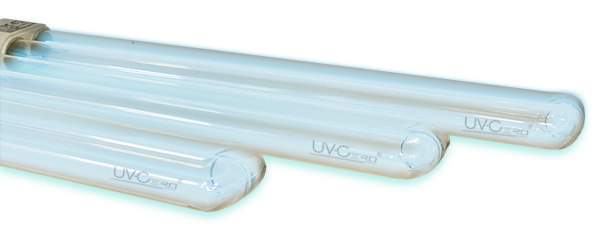
is a highly effective method of removing viruses from our environment. The technology of UV irradiation has been known for approximately one hundred years and is mainly used in medicine and food production. The onset of the coronavirus pandemic has now broadened the scope of application. UVC lamps are one of the most effective devices for the elimination of bacteria,
viruses and fungi.
Cell structure before UV-C irradiation

Cell structure after UV-C irradiation

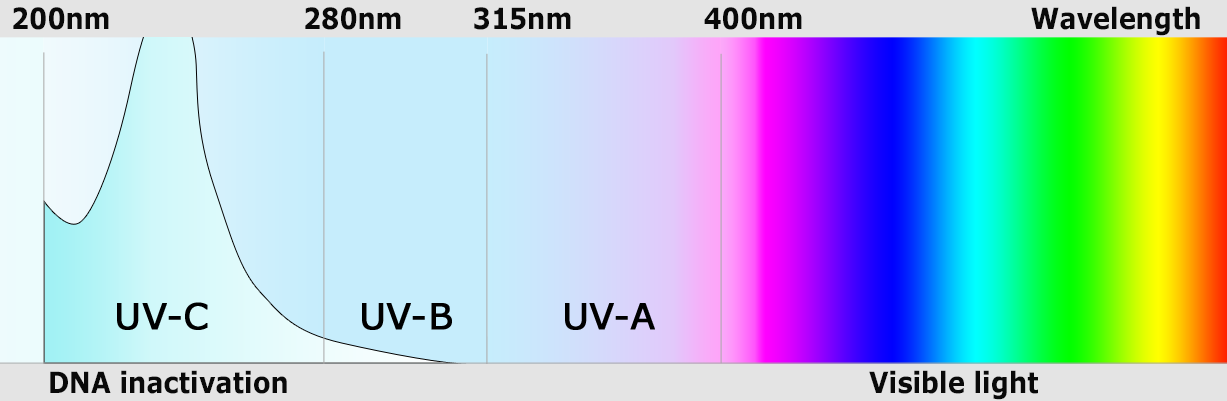
Exposing microorganisms to UVC radiation inactivates their DNA and RNA. Irradiation with UVC light has become an effective, convenient, affordable and environmentally friendly form of decontamination. UVC disinfection requires no human labour and consumes no chemical agents. Consequently, it is cost-efficient and ecologically sound. It also minimises the consumption of chemical disinfectants.
Our business is the UV-C disinfection of air-borne particles.
In this process, air is sucked in with fans, directed past UV-C light and irradiated for a set length of time.
At the outlet, the disinfected air is released with a deactivation rate of 99,9% (test report).
And the equipment has been proven to be absolutely radiation-proof (test report)
-> Can other manufacturers say that of
their products?

> Why not just filter?
A filter system with a HEPA-standard filter ought to suffice. But in order to purify the necessary volume of air per hour, these systems have to be large – there is no other way. Many are also noisy in comparison, and the filter has to be changed regularly, which entails a certain degree of unreliability: the regular filter change is going to be neglected after the second or third time at the latest – that’s just human nature! Furthermore, HEPA filters do not exactly come cheap.
> Time as a factor in UV-C irradiation
The time factor is very important for UV-C irradiation of the air. UV-C irradiation of the extracted air is noiseless – you only hear the fans inside the housing. For the viruses and mutant forms that currently pose a threat to us, barely two seconds of intensive UV-C irradiation is required. The time element is absolutely critical, according to the experts. Most systems currently available on the market blow the air over the integrated UV-C tubes in little more than half a second. This is far too short a duration. The DNA structure of these viruses is not completely destroyed until just under 2 SECONDS have elapsed. This is the way to neutralise SARS viruses and their mutant forms. As a bonus, the system also eliminates the various influenza viruses that make their way to the northern hemisphere every winter.
Why the mutant forms as well?
Because they are variants of a virus, and virus elimination is our business.
> Others may claim the same...
... but we can prove it with our test report that confirms a 99.9% deactivation rate. It was produced by a research laboratory specialising in photonics and virology. -> Interested? Then read the report yourself.